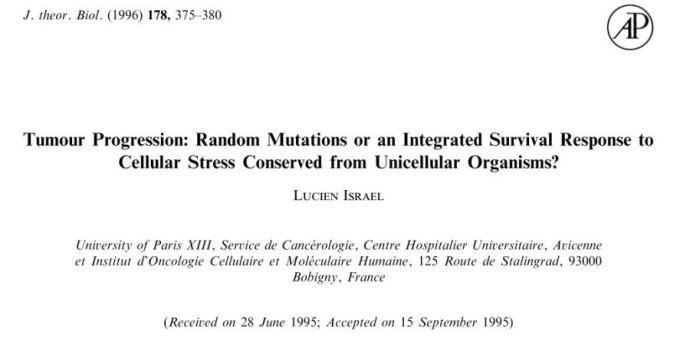
1) MUT001 Lucien I. (1996) “Tumour Progression: Random Mutations or an Integrated Survival Response to Cellular Stress Conserved from Unicellular Organisms?” Journal of Theoretical Biology 178(4):375-380. (link)
2) MUT002 Michel B. (2005) “After 30 Years of Study, the Bacterial SOS Response Still Surprises Us”. PlosBiology 3(7):1174-1176. (link)
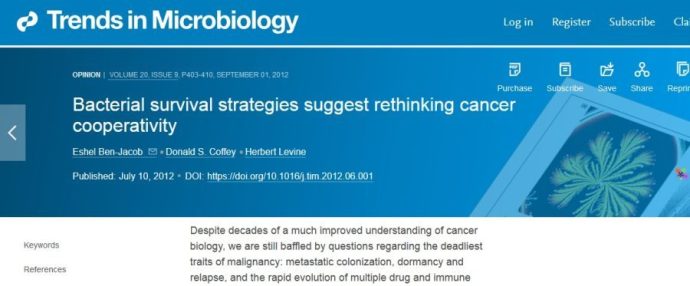
3) MUT003 Ben-Jacop et al. (2012) “Bacterial survival strategies suggest rethinking cancer cooperativity”. Trend in Microbiology 20(9):403-410. (link)
4) MUT004 Cipponi e Thomas (2014) “Stress-induced cellular adaptive strategies: Ancient evolutionarily conserved programs as new anticancer therapeutic targets”. Bioessays 36 (6): 552-560. (link)
5) MUT005 Li et al. (2021) “Non-Coding RNAs in Glioma Microenvironment and Angiogenesis”. Frontiers in Molecular Neuroscience 14. (link)
6) MUT006 Moore et al. (2021) “Exosomes in the Healthy and Malignant Bone Marrow Microenvironment”. In: Banerjee D., Tiwari R.K. (eds) Tumor Microenvironment: Cellular, Metabolic and Immunologic Interactions. Advances in Experimental Medicine and Biology, vol. 1350:67-89. Springer, Cham. (link)
7) MUT007 Matejka e Reindl (2019) “Perspectives of cellular communication through tunneling nanotubes in cancer cells and the connection to radiation effects”. Radiation Oncology 14, 218 (link)
8) MUT008 Kato et al. (2022) “La formazione di tunnel di nanotubi promuove la sopravvivenza contro il 5-fluorouracile nelle cellule di cancro al seno MCF-7 – Tunneling nanotube formation promotes survival against 5‐fluorouracil in MCF‐7 breast cancer cells”. Federation of European Biochemical Societies (FEBS) 12(1): 203–210 (link)
9) MUT009 Pasquier et al. (2013) “Il trasferimento preferenziale dei mitocondri dalle cellule endoteliali alle cellule tumorali attraverso nanotubi a tunnel modula la chemioresistenza – Preferential transfer of mitochondria from endothelial to cancer cells through tunneling nanotubes modulates chemoresistance”. Journal of Translational Medicine, 11:94. (link)
10) MUT010 Desir et al. (2018) “I tunnel di nanotubi indotti dalla chemioterapia mediano l’efflusso di farmaci intercellulari nel cancro del pancreas – Chemotherapy-Induced Tunneling Nanotubes Mediate Intercellular Drug Efflux in Pancreatic Cancer”. Scientific reports 21;8(1):9484 (link)
11) MUT011 Roehlecke e Schmidt (2020) “Tunnelling di nanotubi e microtubi tumorali nel cancro – Tunneling Nanotubes and Tumor Microtubes in Cancer”. Cancers, 12(4), 857 (link)
12) MUT012 Russo et al. (2019) “Mutabilità adattativa dei tumori del colon-retto in risposta a terapie mirate – Adaptive mutability of colorectal cancers in response to targeted therapies.” Science 366 (6472): 1473-1480. (link)
13) MUT013 Lambert et al. (2011) “Un’analogia tra l’evoluzione della resistenza ai farmaci nelle comunità batteriche e nei tessuti maligni – An analogy between the evolution of drug resistance in bacterial communities and malignant tissues”. Nature Reviews Cancer 11, 375–382. (link)
14) MUT014 Quistini et al. (2025) “Segnalazione del recettore degli androgeni nel cancro alla prostata: meccanismi di resistenza alle terapie endocrine – Androgen Receptor Signalling in Prostate Cancer: Mechanisms of Resistance to Endocrine Therapies.” Research and Reports in Urology 2025:17 211–223 (link)
15) MUT015 Kuijk et al. 2022 “Le comuni terapie antitumorali inducono mutazioni somatiche nelle cellule staminali dei tessuti sani- Common anti-cancer therapies induce somatic mutations in stem cells of healthy tissue” Nature communications 13: 5915 (2022). (link)
16) MUT016 Li et al. (2016) “Le radiazioni inducono la generazione di cellule staminali tumorali: un nuovo meccanismo per la radioresistenza del cancro – Radiation induces the generation of cancer stem cells: A novel mechanism for cancer radioresistance” Oncology Letters, 12(5):3059–3065 (link)
Articoli del blog in “Mutagenesi”